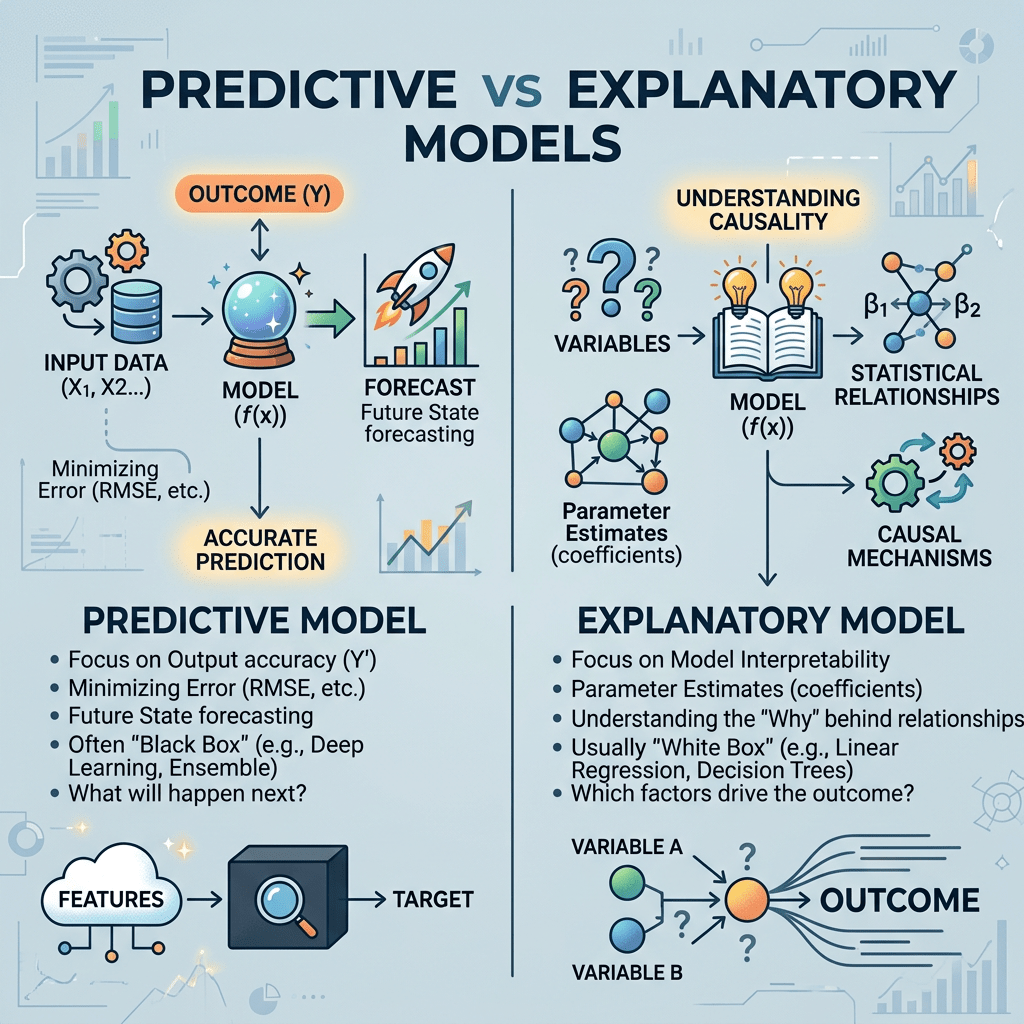
Two questions sound almost the same and are not. One is: what will happen? The other is: why does it happen, and what should we change? A model can be excellent at the first and useless at the second, and confusing them is one of the most common and costly mistakes in applied analysis. It is getting more common as predictive tools spread into places that used to rely on explanation.
Galit Shmueli drew the line cleanly in a 2010 paper whose title is the whole question: to explain, or to predict? Explanatory modeling tests a theory about why something happens, so it cares about getting the underlying structure and the coefficients right. Predictive modeling forecasts new cases, so it cares about one thing, accuracy on data the model has not seen. These are different goals, and they lead to different decisions at every step, from variable selection to model complexity to how you judge success. Start from the same data with different goals and you end up with different models.
The reasons they diverge are worth seeing concretely. A predictive model will happily use a variable that is a downstream consequence of the outcome, or a proxy, or a common effect of two other things, as long as it sharpens the forecast. An explanatory model has to exclude exactly those, because putting them in corrupts the estimate of the cause you care about, a lesson this series has drawn before about controlling for the wrong variable. A superb predictor can be a terrible thing to adjust for.
Bias behaves differently too. Prediction will accept a little bias in exchange for lower variance, since a slightly biased model often forecasts new data more accurately, which is why methods that deliberately shrink estimates toward zero are standard predictive tools. Explanation wants an unbiased estimate of the parameter even at the cost of precision, because a biased coefficient is a wrong answer to how much something matters. The best predictive model is often intentionally biased in ways an explanatory one could not tolerate.
And success is judged differently. A predictive model is judged out of sample, on how well it forecasts cases it never saw, the discipline this series covered under overfitting. An explanatory model cannot be judged that way, because no accuracy score can tell you whether the assumptions that license a causal reading hold. A model can predict beautifully and carry a completely wrong story about why.
That is where the real damage happens. The most common mistake is to build a model for prediction and then read its coefficients as if they explained. A variable that ranks high in predictive importance is not therefore a cause, and changing it will not necessarily change the outcome. Predictive importance answers whether something helps forecast, not whether it drives the result. Acting on a strong predictor as though it were a lever is how you try to change the temperature by adjusting the thermometer.
The repair is unglamorous: decide the goal before you model, and say it out loud. If you need a forecast, optimize and validate for out-of-sample accuracy, and do not interpret the coefficients as causes. If you need to explain, or to decide what to change, build for identification, choose variables by their causal role rather than their predictive punch, and judge the model by whether its assumptions hold. Only the explanatory reading licenses the sentence change this to move that. Prediction tells you where to look; explanation tells you what to do.
This is not abstract for anyone in government. Agencies increasingly run predictive models, risk scores, early-warning flags, targeting tools, and then face pressure to explain them and act on their inputs. A model that forecasts who is likely to drop out or be readmitted is answering a prediction question, and its most important features are not a menu of policy levers. Treating them as levers, or as an explanation of why a group scores high, is a category error with real consequences for who gets helped.
So here is my question for the group. Before you build or trust a model, do you decide whether you are trying to predict or to explain, and do you resist reading a forecast as if it told you what to change?


Leave a comment