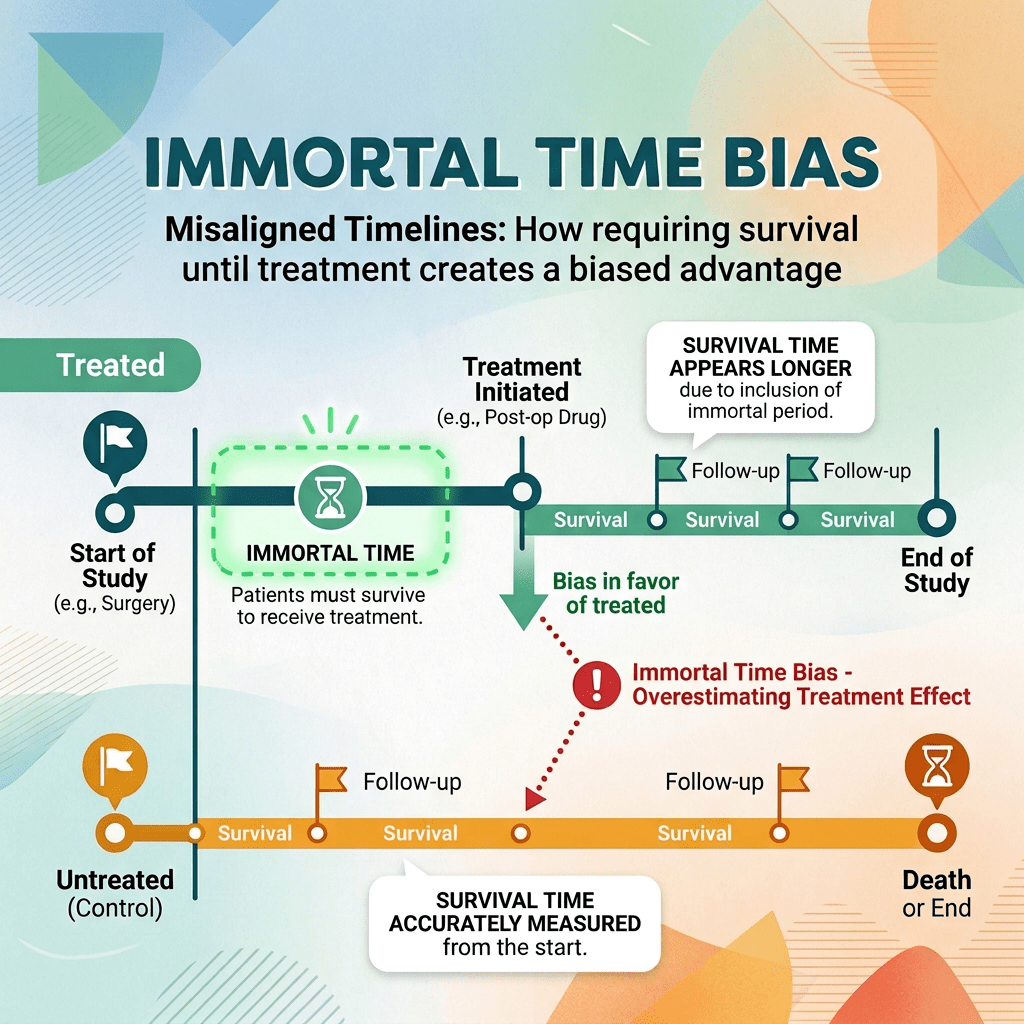
Observational studies keep discovering that people who did a certain thing live longer. Patients who filled their prescriptions outlive those who did not. Heart transplant recipients outlive those on the waiting list. Oscar winners outlive the nominees who lost. Some of these gaps are real. Many are an illusion produced by a single, subtle flaw in how the groups were defined, and the flaw has a name: immortal time bias.
The idea is easier to feel than to state. To end up in the group that filled a prescription, you had to live long enough to fill it. To count as a transplant recipient, you had to survive on the list until an organ arrived. To win an award, you had to be alive on the night it was given. The stretch of time between the start of follow-up and the moment you qualified is time during which, by the very definition of the group, you could not have had the event: if you had died, you would not be a filler, a recipient, or a winner, you would be in the other group. That guaranteed, event-free stretch is the immortal time.
The bias appears when that immortal time gets handed to the treated group. In some studies it is counted as time under treatment, even though treatment had not started. In others, people who die during it are quietly moved into the comparison group or dropped. Either way, the treated group is credited with a block of survival no treatment produced, because that survival was a precondition for being in the group at all. The comparison is tilted before the treatment can do anything, and it tilts in a predictable direction: toward making the treatment look protective.
The reason it is so easy to commit is that nothing about it looks like an error. The groups are real, the people genuinely received the treatment, the data are accurate, and the analysis is a standard survival model. The flaw is not in the measurement or the sample; it is in the alignment of time. The clock for the treated group effectively starts late, or their early, guaranteed survival is counted as if the treatment had earned it. That is why it slips past researchers careful about everything else.
The most famous illustration is the finding that Oscar winners live years longer than other nominees, once offered as evidence that status and esteem lengthen life. But a winner had to survive to the ceremony, and to every later ceremony that made them a winner rather than a hopeful. When the advantage was reanalyzed with the time properly aligned, so that no one was credited for years they simply had to be alive to accumulate, most of the effect dissolved. The prize had not added the years; the years had been a requirement for the prize.
The repair is to align the clock. Everyone’s follow-up must start at the same well-defined moment, and treatment must be handled as something that happens at a point in time rather than a label applied to a whole history in hindsight. In practice that means letting a person contribute untreated time until the treatment begins and treated time only afterward, or choosing a landmark moment and classifying everyone by their status then, discarding the immortal stretch. Most generally, it means specifying the study as the randomized trial you wish you could run, with one clear moment of eligibility and assignment, the target trial emulation an earlier post described, which was built precisely to make immortal time impossible.
This is not only a clinical problem. Any evaluation built on administrative data where participation takes time to accrue is exposed. Compare people who completed a training program with those who did not, and remember that completers had to stay enrolled long enough to finish. The time they spent getting there can be silently credited to the program, so the apparent effect of completing is partly the effect of not having left early. Whenever the exposure is defined by something that takes time, ask whether the treated group was quietly granted immortal time.
So here is my question. When your treated group is defined by something that took time to happen, have you checked that you are not crediting the treatment for the survival it required in the first place?


Leave a comment