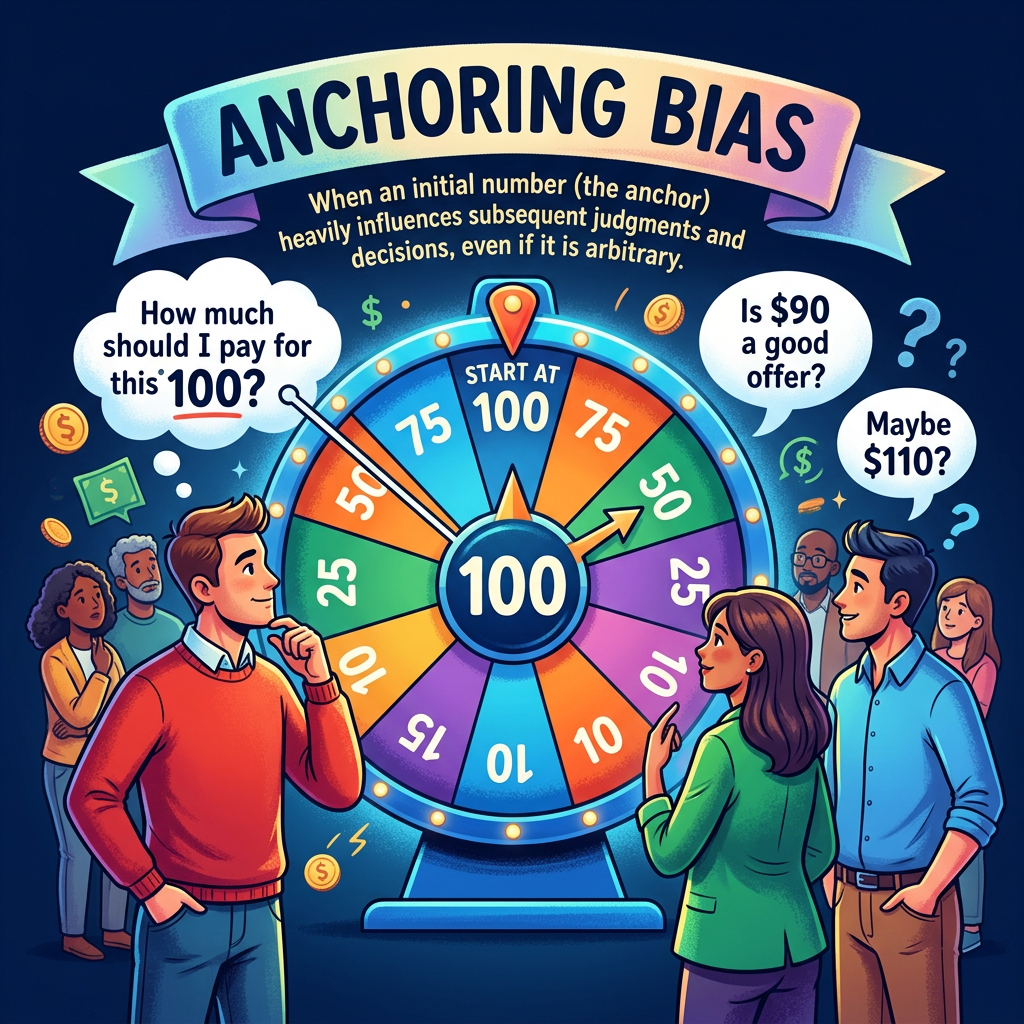
Someone says a number out loud, a budget figure, a timeline, a rough guess, and from that instant your own estimate is quietly bent toward it. Not because the number was correct. Often it was arbitrary, sometimes obviously so, and you knew it. Yet it moved you anyway. This is anchoring, and it is one of the most reliable and least escapable biases in all of human judgment.
The classic demonstration is almost unfair in how well it works. In 1974, Amos Tversky and Daniel Kahneman sat people in front of a wheel of fortune, numbered 0 to 100 but secretly rigged to stop on either 10 or 65. After the wheel landed, they asked each person whether the percentage of African countries in the United Nations was higher or lower than that number, and then asked for their best estimate. The people who saw 10 gave a median estimate of 25 percent. The people who saw 65 gave a median estimate of 45 percent. A number pulled from a spinning wheel, visibly random and plainly irrelevant to African geography, dragged the answers twenty points apart.
The mechanism is a shortcut we all use. Faced with an uncertain quantity, we do not build an answer from nothing. We grab whatever value is nearby and adjust away from it, and the adjustment is almost always too small. We stop before we have moved far enough, and we come to rest closer to the anchor than we should. Any number in the vicinity becomes the starting line, whether or not it has any right to be.
Here is the part that should worry us. Anchoring does not go away when you know about it. It survives explicit warnings, it survives knowing the anchor is random, and it survives paying people to be accurate; Tversky and Kahneman found that offering rewards for correct answers did not shrink the effect. Later work showed that even absurd anchors work, that asking whether Einstein first visited the United States before the year 1215 anchors people about as well as a plausible date. Expertise is thin protection, because experts anchor on irrelevant numbers much like everyone else. You cannot simply resolve not to be anchored.
In our line of work the anchors are everywhere, and they arrive early. A client mentions an off-hand budget, and every cost estimate that follows orbits it. A previous contract’s price becomes the gravitational center of the new one. In a negotiation, the opening offer sets the terms of the whole exchange, which is why a first number, even an aggressive one, is so powerful. And when we lean on expert judgment, asking a panel to estimate an effect size, a prevalence, a risk, showing them a preliminary figure quietly contaminates the judgment we came to collect.
Because willpower does not work, the defenses have to be structural. Collect estimates independently before anyone says a number aloud, so no single figure anchors the group. When an anchor is unavoidable, make it a defensible one: replace the arbitrary starting point with real reference data, the distribution of similar past projects, which is the outside view this series has praised before. Force yourself to consider the opposite, generating reasons the true value could be far higher or far lower before you settle. And ask for a range built from evidence before anyone commits to a point.
The through-line is simple. The first number in the room is doing work, whether or not it has earned the right to. Half the discipline is noticing that it is happening at all. The other half is arranging the process so the anchor that shapes the answer is a piece of evidence you chose on purpose, not a figure that happened to be said first.
So here is my question. When your team lands on an estimate, do you know what number it started from, and whether that starting point was evidence or an accident?


Leave a comment