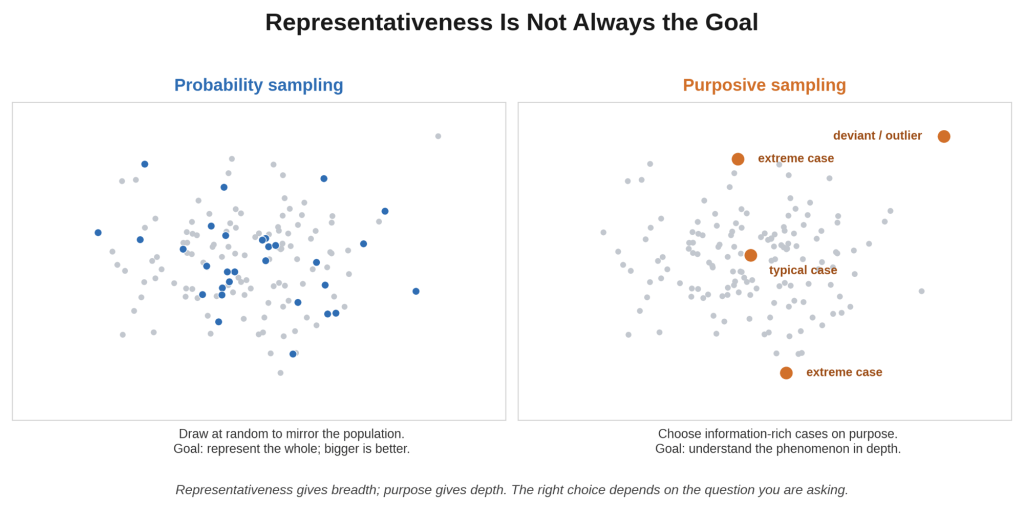
Ask most people how to choose a sample and they will describe some version of representativeness: draw at random so the sample mirrors the population, and the larger the better. That instinct is right for one job, estimating a quantity in a population. It is the wrong instinct for much of qualitative work, where the goal is not to mirror a population at all. There, the point of sampling is to learn as much as possible about a question, and the best sample is the one that teaches you the most, not the one that looks most like the whole.
This is purposeful sampling, and it is one of the defining features of qualitative inquiry. As Michael Quinn Patton puts it, the logic and power of the approach lie in selecting information-rich cases, the ones whose study will illuminate the question in depth. You are not trying to average across a crowd. You are trying to understand a phenomenon, and some cases reveal far more about it than others. Choosing those cases on purpose is not a compromise forced by a small budget. It is the method.
The strategies differ because different questions call for different cases. Maximum variation sampling deliberately spans the range, so that whatever patterns hold across very different circumstances are likely robust, and the differences themselves are informative. Extreme or deviant case sampling goes to the outliers, the notable success or the striking failure, because the unusual case often exposes what stays hidden in the typical one. Critical case sampling picks the case that settles the matter: if it cannot work here, it will not work anywhere. And disconfirming case sampling seeks the examples that might break an emerging pattern, marking the boundary of a claim, the qualitative cousin of hunting for the case that breaks your theory.
There is an even more dynamic version. In theoretical sampling, associated with grounded theory, you do not fix the sample in advance at all. You collect and analyze together, and the developing analysis tells you who or what to sample next: a concept is emerging, so you go looking for the case that will sharpen or challenge it. Sampling becomes a series of analytic decisions rather than a plan set before the first interview, and it continues until new cases stop changing the picture.
This reframes the question people love to ask, which is how many. In qualitative work the honest answer is not a number from a power calculation but a judgment about information. Malterud and colleagues gave this a useful name, information power: the more relevant information your sample already holds, the fewer participants you need. A narrow, well-specified question studied through rich dialogue can be answered with a handful of well-chosen cases; a broad, loosely defined one may need many more. Sufficiency, not size, is the standard.
Two honest cautions keep this from becoming an excuse. First, purposeful is not the same as convenient. Choosing the cases that are easiest to reach is the weakest form of sampling, information-poor and low in credibility, and it is not what any of this endorses. The selection logic has to be explicit and defensible, because purposeful sampling gives the researcher the power to shape the sample, and that power quietly becomes cherry-picking if the reasoning is not on the table. Second, this kind of sample does not generalize by statistics. It generalizes, when it does, by transferability: you give enough about the cases and their context that a reader can judge whether the findings extend to their own setting.
It is worth noticing that this is the mirror image of an earlier post. A nonprobability sample is dangerous when you want to estimate a population, because its bias does not shrink as it grows. The very same nonprobability logic is the right choice when the goal is understanding rather than estimation. The tool did not change; the question did.
So here is my question. When you choose whom to study, do you reach reflexively for a representative sample, or do you first ask what you are trying to learn and which cases would teach you the most?


Leave a comment